
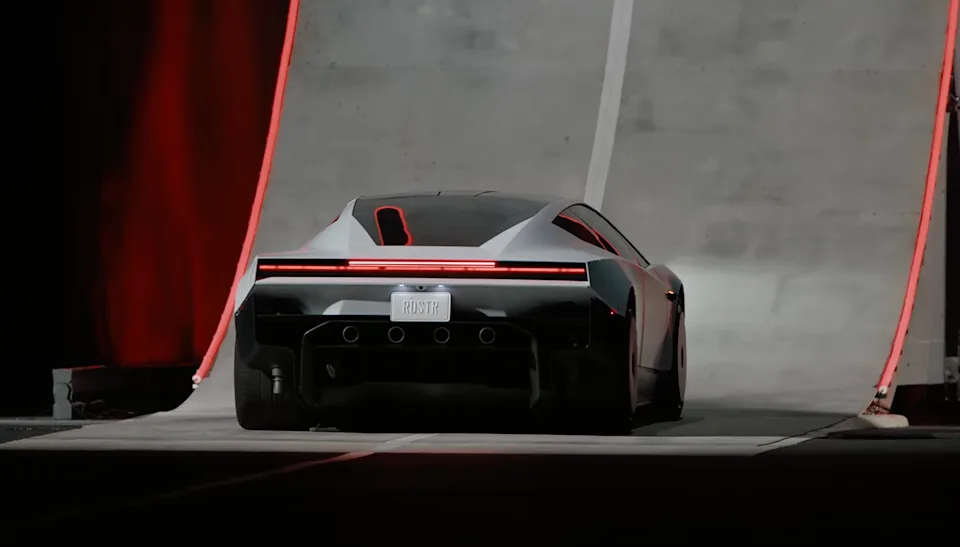
Tesla spent nearly nine years bringing the next-generation Roadster back into the spotlight. When it finally arrived, apparently driving very fast was no longer enough.
At the October 15 reveal, Tesla demonstrated a redesigned Roadster equipped with SpaceX-developed thrusters, including dramatic aerial maneuvers. Tesla says the car can accelerate from 0–60 mph in under one second, with production currently targeted for 2028. Reuters
That left us with one extremely serious journalistic question:
If the car is already leaving the ground, why should roads get to decide where it goes next?
So we opened Movmix AI Video Generator and gave the Roadster an itinerary that may be slightly outside the jurisdiction of the Department of Motor Vehicles.
Moon. Mars. An aircraft carrier. And, eventually, a rocket ride.
Note: The Moon, Mars, aircraft carrier, and extended space-travel scenes below are AI-generated creative concepts, not footage of actual Tesla tests.
1. First Stop: The Moon. Plenty of Parking, Not Many Chargers
We started with the most reasonable unreasonable destination: the Moon.
In our AI video, a silver futuristic sports car hovers above the lunar surface. Thrusters fire beneath it, dust spreads across the ground, and the car gently touches down with Earth hanging in the distance.
Traffic is excellent.
The nearest Tesla Service Center may be a problem.
What makes the scene work is that the Roadster still looks like a believable car. Its body, wheels, glass and reflections remain familiar while everything around it says that a car absolutely should not be here.
That combination — familiar object, impossible location — is exactly what makes an AI scene instantly understandable.
2. The Moon Felt Quiet, So We Took It for a Drive on Mars
For the second video, we skipped the landing ceremony.
The Roadster has apparently adapted to interplanetary life already.
The car speeds through a red Martian landscape, throwing dust behind its wheels as rocky terrain and canyon walls stretch into the distance.
It looks suspiciously like an automotive commercial with a production budget nobody approved.
The only obvious problem is that Google Maps probably has not indexed this road yet.
Visually, this scene works better with movement than with a parked car. As the landscape unfolds around the Roadster, the clip stops feeling like a sci-fi poster and starts feeling like an actual road trip.
Just one with slightly ambitious directions.
3. Back on Earth: Naturally, We Chose an Aircraft Carrier
After two extraterrestrial stops, we decided to bring the car back to Earth.
We did not choose a normal road.
The video opens over the ocean before revealing a massive aircraft carrier. Then the Roadster appears, racing along the flight deck.
The interesting part here is scale.
On a city street, a sports car feels wide, low and aggressive. Put the same vehicle on an enormous carrier deck and it suddenly looks almost like a remote-controlled toy.
We did not test whether it could drive off the deck and start flying.
Even AI journalism needs standards.
4. About That Idea of Sending a Tesla Into Space…
At this point, the story requires an inconvenient fact:
Elon Musk already did the ridiculous part.
On February 6, 2018, SpaceX launched Falcon Heavy for the first time. Its payload included Musk’s Tesla Roadster and a mannequin passenger named Starman. The vehicle was sent into an orbit around the Sun. SpaceX still lists the mission as Falcon Heavy’s first flight. SpaceX Content
So “put a sports car on a giant rocket” is not our AI prompt.
It is history.
That gave us a convenient starting point for the final experiment.
Reality could handle the launch.
We would let AI handle what came next.
5. What If the 2018 Roadster Had Kept Going?
The last video is the most complete story of the set.
It begins at the launch site.
The rocket ignites and rises from Earth. The story moves into space, then toward the Moon. The Roadster reaches the lunar surface, lands, and eventually begins driving across it.
A remarkably efficient space program.
In reality, the 2018 Roadster did not land on the Moon. It was sent into a heliocentric orbit around the Sun. SpaceX Content
Our version creates an alternate timeline:
Earth → Rocket Launch → Space → Moon → First Lunar Road Trip
And that is where AI video becomes more interesting than a single visual effect. Several impossible shots can be connected into something with a beginning, a destination and a payoff.
Watch the Tesla Roadster AI Experiment
We started with one simple question: if the Roadster is already borrowing technology from SpaceX, how far can we push the idea with AI?
The result went far beyond an ordinary car commercial. We imagined the Roadster leaving familiar roads behind and entering places a production car was never designed to visit—from extraterrestrial landscapes to completely impossible driving environments.
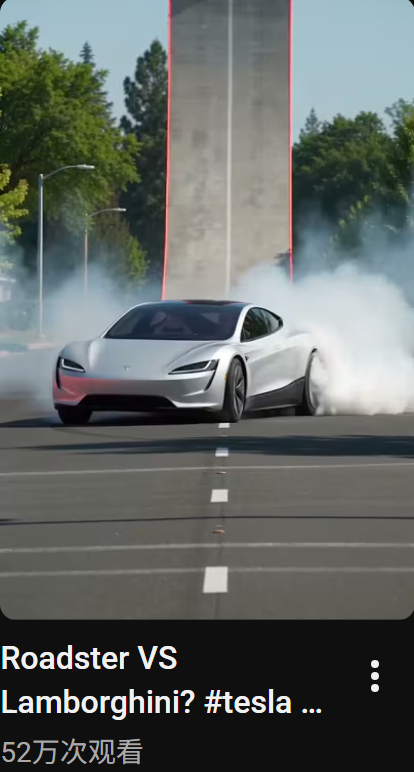
Watch the Tesla Roadster AI Video on YouTube
From a News Story to an AI Visual Experiment
The Roadster reveal gave us the starting point, but the AI video let us continue the story in our own direction. Instead of asking what Tesla actually plans to do next, we asked a much more entertaining question:
What would we want to see next?
That is also why we created these scenes as a visual experiment rather than a prediction. The Moon, Mars and other environments are fictional AI concepts—but they show how quickly a real-world news moment can become new visual content.
When a Car Starts Flying, Is It Still Just a Car?
The most interesting thing about the new Roadster may not be one acceleration figure.
Tesla is borrowing technology from SpaceX. A sports-car reveal is now featuring thrusters and mid-air maneuvers. Meanwhile, Tesla itself is increasingly presenting its future around AI, robotics and autonomous technology as much as conventional automobiles. Reuters
The categories are getting blurry.
And that happens to be exactly where generative video is useful.
News tells us what happened.
AI is unusually good at asking:
What happens next?
The Moon, Mars and aircraft carrier are obviously our inventions. But there is a funny historical problem with calling them “too ridiculous.”
In 2018, if someone had written:
Put a red sports car on Falcon Heavy, send it into space, and leave a mannequin behind the wheel.
It would have sounded like an AI prompt.
Then SpaceX actually did it. SpaceX Content
How We Made the Videos
The workflow was considerably easier than actually launching a Roadster into space.
We first created a strong first-frame image that established the car, environment and camera position. Then the video model handled movement: the vehicle descending, lunar dust spreading, wheels turning, Martian terrain passing by, or a rocket leaving the launch pad.
Start with a strong first-frame image, upload it to Movmix, choose a model, and then use the Video Prompt to control exactly what happens next.
If you already have a car image and an idea that probably violates several laws of physics, you can start with Movmix AI Image to Video.
We do not know whether a Roadster will ever actually reach the Moon.
But at least now, we do not have to wait until 2028 to see what it might look like.
Click here to create your own AI video for free with Movmix.
Reference Link: